
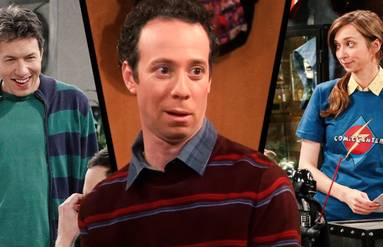
Stuart’s quiet presence at the comic book store was always a background beat in The Big Bang Theory. While Sheldon debated the merits of string theory and Leonard navigated romantic misfires, Stuart stood behind the counter—awkward, underappreciated, and oddly relatable. Now, he’s stepping into the spotlight in an unexpected new spinoff where, against all odds, he’s thrust into a universe-threatening crisis—and fails spectacularly. The first look at Stuart Fails to Save the Universe reveals a darker, more surreal comedic direction, one that dares to ask: what happens when the least confident guy in Pasadena becomes the last hope for reality itself?
This isn’t the Young Sheldon route of prequel nostalgia. It’s a metaphysical leap—one that blends character-driven humor with absurd sci-fi stakes and a quiet melancholy that feels deeply human.
From Comic Book Clerk to Cosmic Failure
The premise of the spinoff hinges on an accidental discovery: while sorting through a box of vintage Action Comics, Stuart uncovers a sentient comic book artifact known as the "Panels of Entropy." When he reads it aloud during a slow Tuesday shift, he unknowingly triggers a dimensional rift. Reality begins to glitch—characters from other TV shows make awkward cameos, time loops trap Pasadena in endless Wednesday afternoons, and Howard’s voice randomly echoes from toasters.
Instead of rising to the occasion, Stuart panics. He misreads ancient instructions, attempts to barter with interdimensional entities using store credit, and tries to outsource the crisis to Sheldon via recorded message. The core joke? The universe picks the worst possible savior—and he knows it.
Early footage shows Stuart, wide-eyed and wearing mismatched socks, trying to reassemble a shattered spacetime continuum using only a Hot Wheels track, a broken espresso machine, and vintage Green Lantern issues. He fails—every time. But in failing, he becomes more endearing, more grounded, and more honest than any traditional hero.
Why This Spinoff Works
Most spinoffs fail because they try to replicate the old magic. Joey tried to transplant a sitcom character into a new city and collapsed under the weight of expectation. This new series avoids that trap by embracing Stuart’s fundamental traits: anxiety, humility, and quiet resilience.
It also takes creative risks. The show leans into surreal, almost Twin Peaks-meets-Rick and Morty visuals. One scene shows Stuart floating in a void made entirely of rejected comic book pitches. Another has him negotiating with a sentient vending machine that claims to be the true God of the Multiverse.
But beneath the absurdity, the show remains emotionally anchored. Stuart isn’t just battling cosmic forces—he’s battling self-doubt, loneliness, and the nagging sense that he was never meant for greatness. That relatability is what makes the concept resonate.
The Creative Team Behind the Madness
Chuck Lorre, co-creator of The Big Bang Theory, returns as showrunner alongside a new writing team that includes alumni from Community and The Good Place. Their influence is evident in the show’s layered humor and philosophical undercurrents.
Jim Parsons reprises his role as narrator, offering wry, omniscient commentary on Stuart’s misadventures. His voice is now older, slightly weary—like a god who regrets giving free will to mortals.
Johnny Galecki and Mayim Bialik are listed as executive producers, though they won’t appear on screen. Their involvement suggests a level of oversight that keeps the tone consistent with the original series’ emotional intelligence.
First Look: What We’ve Seen So Far
A 90-second teaser released at CBS’s upfront presentation offers the first real look at the series’ tone and visuals:
- Opening Scene: Stuart restocking shelves when the store lights flicker. A voice whispers, “You’re the Chosen One.” He responds, “I think you have me confused with someone else. I still owe Leonard $12 for parking.”
- The Artifact: A glowing comic book with shifting panels. When touched, it displays images from alternate realities—Stuart as a rockstar, a Nobel laureate, a cult leader.
- The Glitch: Time freezes. Everyone stops mid-motion except Stuart. A raccoon in a lab coat appears and says, “You broke causality. Fix it. Or don’t. Honestly, I’m just observing.”
- The Failure: Stuart builds a “reality stabilizer” out of a microwave, Christmas lights, and a kazoo. It explodes, turning everyone’s hair purple for 72 hours.
The teaser ends with Stuart sitting on a rooftop, eating cold Chinese food, saying, “I don’t want to save the universe. I just want someone to text me back.”
It’s funny, yes—but it’s also quietly devastating.
How Stuart Differs from Other Big Bang Characters
Stuart was never a punchline in the same way as Raj’s selective mutism or Howard’s mother jokes. His humor came from discomfort, silence, and the kind of loneliness that doesn’t announce itself.
This spinoff leans into that. While the original cast thrived on intellectual superiority, Stuart’s power lies in his lack of ego. He doesn’t understand the science. He doesn’t want the spotlight. But he keeps showing up—even when every attempt to fix things backfires.
Examples from early scripts illustrate this:
- He tries to contact the “Council of Heroes” via a poorly moderated Reddit thread. They dismiss him as a troll.
- He attempts to train like a superhero, but his workout consists of lifting old comic books and doing push-ups between customer transactions.
- When offered temporary omnipotence, he uses it to make sure everyone’s Wi-Fi works perfectly for one day.
These moments aren’t just jokes—they’re character studies in humility and quiet persistence.
The Risk of Over-Explaining the Joke
One danger of the premise is turning Stuart’s failure into a repetitive gag. If every episode ends with the universe still broken and Stuart looking sheepish, the show could become stagnant.
To avoid this, the writers are using a “failure arc” structure. Each episode, Stuart fails—but his failures accumulate into unintended progress. For instance:
- Episode 3: He tries to close a black hole with a vacuum cleaner. It backfires, but accidentally stabilizes Earth’s magnetic field for a century.
- Episode 5: His botched time travel creates a paradox that erases a minor war—but also causes all cats to briefly speak fluent German.
The message isn’t that failure is noble. It’s that progress is messy, nonlinear, and often accidental. That’s a surprisingly mature theme for a network sitcom.
Guest Appearances and Cameos
While the original cast won’t return as regulars, several are expected to appear in dream sequences, hallucinations, or alternate realities.
Leaked set photos show:

- Kaley Cuoco’s Penny appearing as a hologram bartender in a dimension where everyone speaks in sitcom laugh tracks.
- Simon Helberg’s Howard in a flashback where he unknowingly gives Stuart bad advice that triggers the main crisis.
- Jim Parsons appearing as a higher-dimensional version of Sheldon who speaks only in passive-aggressive equations.
These appearances aren’t just fan service. They serve to highlight how Stuart’s journey diverges from the main cast’s—where they sought achievement, he seeks connection.
Why This Spinoff Matters Now
In an era of superhero fatigue and algorithmic content, Stuart Fails to Save the Universe offers something rare: a story where vulnerability is the superpower.
It speaks to a generation that’s tired of “rise and grind” narratives. Not everyone is built to save the world—and maybe the world doesn’t need saving in the way we think. Maybe it needs someone who shows up with a lukewarm coffee and a half-baked plan.
The show’s emotional core is this: you don’t have to win to matter. You just have to try—even if you fail, even if no one sees it.
Final Thoughts: Embracing the Mess
Stuart Fails to Save the Universe isn’t trying to be The Big Bang Theory 2.0. It’s not about witty science banter or romantic subplots between physicists. It’s about the quiet guy in the back room who, when the universe calls, answers—even though he’s terrified.
The first look confirms the show’s bold tone, visual creativity, and emotional depth. It’s a sitcom that dares to be sad, strange, and sincere.
For fans of the original series, this isn’t a replacement. It’s a reinterpretation—one that finds heroism not in genius, but in showing up when you’re certain you’ll fail.
If you’ve ever felt overlooked, underqualified, or out of your depth—this show might just feel like home.
What is the premise of the Big Bang Theory spinoff with Stuart? The spinoff follows Stuart, the comic book store owner, as he accidentally triggers a cosmic crisis and fails repeatedly to fix it—while slowly becoming an accidental hero through his humility and persistence.
Will any original Big Bang Theory characters appear? Yes, several original cast members will appear in guest roles, mostly through hallucinations, alternate realities, or as narrators. Jim Parsons returns as the series’ narrator.
Is the show a comedy or a sci-fi series? It’s a comedic sci-fi with surreal elements. The tone blends absurd humor with emotional depth, similar to shows like The Good Place or Rick and Morty—but with a quieter, more human center.
How many episodes will the first season have? The first season is set for 10 episodes, each 22 minutes long, airing on CBS with streaming availability on Paramount+.
Is Stuart the only main character? Yes, Stuart is the sole central character. The show focuses entirely on his journey, with supporting roles filled by new characters like a sentient comic book and a nihilistic raccoon researcher.
Where can I watch the teaser? The teaser is currently available on CBS’s official YouTube channel and the network’s upfront presentation archive.
Is the show canon to The Big Bang Theory? Yes, it’s considered canon. The series is set several years after the original show ended and references past events, including Leonard and Penny’s marriage and Sheldon’s move to Texas.
FAQ
What should you look for in Stuart Fails to Save the Universe: First Look at the Big Bang Theory Spi? Focus on relevance, practical value, and how well the solution matches real user intent.
Is Stuart Fails to Save the Universe: First Look at the Big Bang Theory Spi suitable for beginners? That depends on the workflow, but a clear step-by-step approach usually makes it easier to start.
How do you compare options around Stuart Fails to Save the Universe: First Look at the Big Bang Theory Spi? Compare features, trust signals, limitations, pricing, and ease of implementation.
What mistakes should you avoid? Avoid generic choices, weak validation, and decisions based only on marketing claims.
What is the next best step? Shortlist the most relevant options, validate them quickly, and refine from real-world results.




:max_bytes(150000):strip_icc():focal(728x275:730x277)/princess-catherine-prince-william-donald-trump-king-charles-iii-trump-state-visit-uk-windsor-091725-8672599a27214b6f8ffdbb07fd7596e4.jpg)
