Every construction site, mining operation, and industrial facility in South Africa shares one urgent need: fast, effective communication about safety. Supervisors know formal training isn't enough—daily reminders cut through complacency. That’s where toolbox talk topics PDF South Africa comes in. These aren’t just documents—they’re frontline tools that bridge policy and practice.
Yet finding relevant, locally compliant content remains a challenge. Generic international templates often miss South African regulations, climate conditions, and common job site hazards. The real value isn’t in volume—it’s in relevance, clarity, and ease of deployment.
This guide cuts through the noise. You’ll get actionable toolbox talk topics tailored to South African work environments, how to use them effectively, and where to source reliable PDFs—without wasting hours searching.
Why South African Workplaces Need Localized Toolbox Talks
Toolbox talks are short safety meetings—usually 10 to 15 minutes—held before work begins. Their purpose is to spotlight hazards, reinforce procedures, and encourage safe behavior. But global templates often fail on the ground in South Africa.
Consider this: - A talk on heat stress needs to reflect the Karoo summer, not Scandinavian winters. - Electrical safety must align with SANS 10142 standards, not IEC alone. - Language and literacy levels matter—simple visuals and plain English outperform legal jargon.
Workplaces using generic PDFs often see poor engagement. Workers zone out when examples don’t match their reality. Supervisors struggle to connect theory to tasks. The result? Sessions become checkboxes, not change-makers.
Localized talks fix this. They reference local sites, common tools, and real incidents. More importantly, they comply with South Africa’s Occupational Health and Safety Act (OHSA) No. 85 of 1993 and its regulations—non-negotiable for audits and incident investigations.
Top 10 High-Impact Toolbox Talk Topics for South Africa
The best topics target frequent risks and high-consequence scenarios. These ten are consistently relevant across sectors like construction, mining, manufacturing, and facilities maintenance.
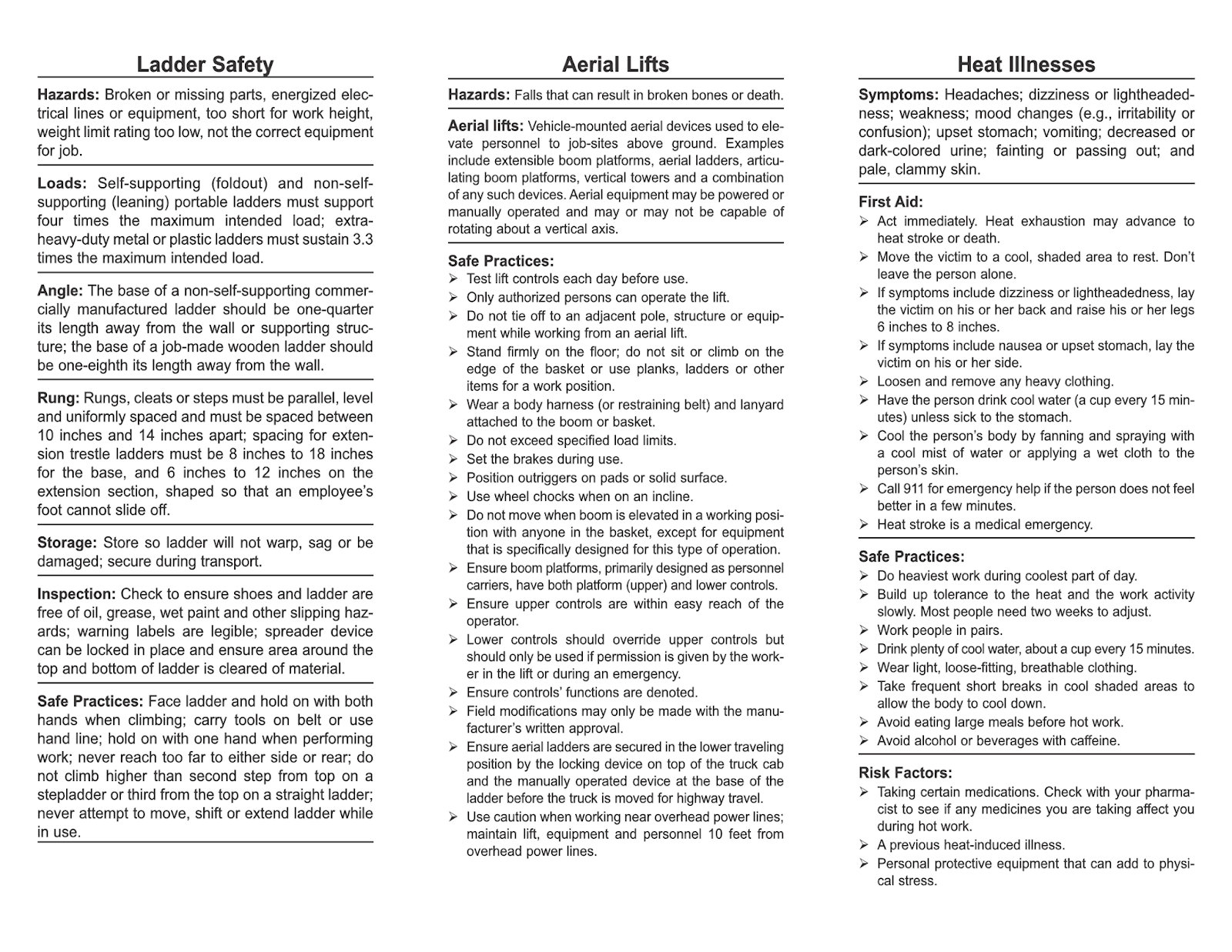
#### 1. Working at Height (Ladders, Scaffolding, Roof Edges) Falls remain a leading cause of serious injury. Talks should cover: - Proper ladder setup (1:4 ratio, secure footing) - Harness use and anchorage points - Weather impact (wind, wet surfaces) Example: A worker in Rustenburg fell from a mobile scaffold after a gust blew it sideways. The talk would analyze anchoring failure and stress pre-shift checks.
#### 2. Manual Handling and Back Safety With limited mechanization on many sites, lifting injuries are common. Focus on: - Correct lifting posture (bend knees, keep back straight) - Team lifts for loads over 25kg - Use of trolleys and hoists
Tip: Demonstrate improper vs. proper technique with a team member during the talk.
#### 3. Electrical Safety (Lockout/Tagout, Overhead Lines) South African sites often deal with temporary power setups. Critical points: - Confirm isolation with a voltage tester - Red tags for locked equipment - Minimum approach distances (e.g., 3 meters from 11kV lines) Use a photo of a real near-miss—like a drill touching a cable—to drive the point home.
#### 4. Hazardous Substances (Chemicals, Asbestos, Dust) From cleaning agents to silica dust, chemical exposure is underreported. Discuss: - Reading Safety Data Sheets (SDS) - PPE requirements (respirators, gloves) - Spill response steps
Add a checklist: “Before using any chemical, I must…”

#### 5. Slip, Trip, and Fall Prevention Simple but deadly. High-risk areas include: - Wet floors in plant rooms - Unmarked cable runs - Cluttered walkways
Example: A maintenance worker in Cape Town slipped on oil near a compressor. The talk would show the scene and ask, “What controls were missing?”
#### 6. Excavation and Trenching Safety Common in municipal and pipeline work. Emphasize: - Soil type and shoring requirements - No entry without a permit - Gas testing in confined spaces
Mistake to avoid: Assuming stable ground after rain.
#### 7. PPE Compliance and Inspection PPE is only effective if used and maintained. Cover: - Daily checks for damage (e.g., cracked hard hats) - Correct fit (gloves too big reduce grip) - Site-specific rules (e.g., hearing protection in high-noise zones) Try a “PPE self-audit”—workers inspect each other’s gear.
#### 8. Fire Prevention and Emergency Response Workshops and storage areas are fire risks. Key actions: - No flammable storage near heat sources - Fire extinguisher types and locations - Evacuation routes and assembly points
Use a site map during the talk to mark exits and extinguishers.
#### 9. Machine Guarding and Isolation Unguarded machinery causes amputations and entanglements. Teach: - Never bypass interlocks - Isolate before cleaning or clearing jams - Verify “zero energy” before servicing
Show a photo of a missing guard—ask the team what’s wrong.
#### 10. Night Shift and Fatigue Management Often overlooked, fatigue impacts decision-making. Address: - Signs of drowsiness (slow reaction, yawning) - Buddy system for high-risk tasks - Reporting when too tired to work safely
Case: A night-shift operator in Durban missed a warning light—resulting in equipment damage.
How to Use Toolbox Talk PDFs Effectively on Site
A PDF isn’t a magic fix. Success depends on delivery. Follow this workflow:
1. Choose the Right Topic Weekly Align with current tasks. If installing roof trusses, pick “Working at Height.” If handling diesel, pick “Hazardous Substances.”
2. Customize the Content Add your company logo, site name, and real examples. Replace generic images with photos from your location. This builds ownership.
3. Print or Use Digitally Many supervisors use tablets or project slides. But printed PDFs work better in areas with poor signal or bright sunlight.
4. Hold the Talk in the Work Zone Don’t gather in the office. Stand near the hazard—by a trench, machine, or scaffold. Proximity increases impact.
5. Encourage Interaction Ask: “Have you seen this risk before?” or “What would you do differently?” Record names and comments to prove attendance and engagement.
6. File for Compliance Keep signed attendance sheets and topic records. SANS 18001 and OHS audits require proof of regular safety communication.
Avoid these mistakes: - Reading the PDF aloud like a script - Skipping talks during busy periods - Using the same topic every month
Where to Find Reliable Toolbox Talk Topics PDFs in South Africa
Not all PDFs are equal. Many free downloads are outdated or poorly structured. Prioritize sources with local compliance expertise.
- #### Trusted Local Sources:
- Department of Employment and Labour (South Africa)
- Offers free safety guidelines and templates aligned with OHSA. Website: labour.gov.za
- SAPCA (South African Plant Hire Association)
- Provides industry-specific talks for plant operators and ground staff.
- NOSA (National Occupational Safety Association)
- Sells comprehensive safety toolkits, including ready-to-use toolbox talk packs.

- OSG (Occupational Safety Group)
- Offers bilingual (English/Afrikaans) PDFs tailored to SA regulations.
- SHEQ Online and SafetyWallet
- Subscription platforms with downloadable, editable PDFs and tracking tools.
Avoid random blog downloads. Check: - Is the material updated post-2020? - Does it reference SANS or OHSA? - Are visual aids clear and relevant?
Building Your Own Toolbox Talk PDFs: A Quick Framework
When pre-made PDFs don’t fit, create your own. Use this template:
Duration: 12 minutes Facilitator: [Name], Safety Officer
Objective: Reduce fall risks during roofing tasks
Key Points: - Harness anchor points must support 15kN - No working in high wind (over 40km/h) - Ladders must extend 1m above landing
Discussion Questions: - Where are the nearest anchor points on this site? - What would you do if a co-worker isn’t clipped in?
Visual Aid: Photo of proper harness setup Action Item: Inspect all ladders today
Attendees: [Signatures] Date: [Field]
Keep it to one page. Use large fonts (12pt minimum) and simple language (Grade 10 reading level). Add your company header and safety slogan.
Common Pitfalls That Undermine Toolbox Talks
Even with great PDFs, these mistakes kill effectiveness:
- Inconsistent scheduling: Talks only before audits signal they’re for show, not safety.
- One-way delivery: Monologues encourage disengagement. Ask questions.
- Ignoring feedback: If workers suggest a topic (e.g., “slippery stairs”), act on it.
- No follow-up: Spot-check behaviors after a talk. Did PPE use improve?
- Overloading content: Focus on one hazard per session. Depth beats breadth.
A platinum mine near Carletonville reduced incidents by 37% after introducing talk reflection sheets—a follow-up form completed 48 hours later asking, “Did this talk change your behavior?”
Final Thoughts: Make Safety Stick
Toolbox talk topics PDF South Africa aren't about collecting documents—they're about changing behavior. The right PDF, used the right way, turns abstract rules into daily habits.
Choose relevant topics. Customize for your team. Deliver with energy and clarity. File proof for compliance.
Download a few sample PDFs from NOSA or the Department of Labour. Run your first talk this week—on a real hazard, with real workers, in real time.
Safety isn’t a folder on a drive. It’s a conversation that never stops.
Frequently Asked Questions
What are toolbox talks in South Africa? Short safety meetings held before work starts, focusing on specific hazards, procedures, and compliance with OHSA regulations.
Are toolbox talks mandatory in South Africa? While not explicitly required by law, they are a recognized best practice under the OHSA and often required by clients, insurers, and safety standards like SANS 18001.
How long should a toolbox talk last? Ideally 10 to 15 minutes—long enough to cover key points, short enough to hold attention.
Can toolbox talks be conducted in local languages? Yes, and they should be. Use materials in English, isiZulu, Afrikaans, or other dominant languages on site for better understanding.
How often should toolbox talks be held? At least weekly on high-risk sites, or whenever new hazards are introduced (e.g., new equipment or tasks).
Do I need to keep records of toolbox talks? Yes. Attendance sheets, topics, and facilitator names must be kept for audits and incident investigations.
Where can I download free toolbox talk PDFs for South Africa? The Department of Employment and Labour, NOSA, and SafetyWallet offer free or low-cost, compliant PDFs tailored to local conditions.
FAQ
What should you look for in Toolbox Talk Topics PDF South Africa: Practical Safety Guides? Focus on relevance, practical value, and how well the solution matches real user intent.
Is Toolbox Talk Topics PDF South Africa: Practical Safety Guides suitable for beginners? That depends on the workflow, but a clear step-by-step approach usually makes it easier to start.
How do you compare options around Toolbox Talk Topics PDF South Africa: Practical Safety Guides? Compare features, trust signals, limitations, pricing, and ease of implementation.
What mistakes should you avoid? Avoid generic choices, weak validation, and decisions based only on marketing claims.
What is the next best step? Shortlist the most relevant options, validate them quickly, and refine from real-world results.


:max_bytes(150000):strip_icc():focal(728x275:730x277)/princess-catherine-prince-william-donald-trump-king-charles-iii-trump-state-visit-uk-windsor-091725-8672599a27214b6f8ffdbb07fd7596e4.jpg)

